


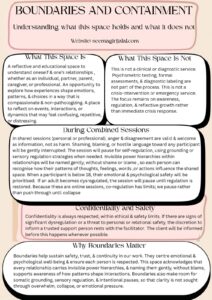
Boundaries often get mistaken for policing or punishment, but the work of holding a space like this sits in a very different place. Calling out harm is necessary, and naming patterns is necessary, but calling someone out cannot turn into calling them down when they are already sitting in front of us trying to understand themselves. If someone learns slowly, or differently, or not in the sequence we expect, yes the harm may continue. And still the only thing that protects the possibility of change is to keep naming what needs to be named with consistency and dignity.
This has been especially true in the work with men. Many men step into a reflective space only because they are not humiliated for trying. I have had the privilege of working with men who return even when I am naming their power, naming the impact of their words, and naming the weight their actions create in relationships. Except for a very small handful across all these years, I carry a lot of hope. But this gentleness did not come easily. As a woman who has been on the receiving end of harm, staying gentle while naming harm has been one of the hardest shifts in my own inner work.
Things changed in a significant way after giving birth to two boys. It raised difficult questions about where we lose our boys. Genetics and epigenetics have their place, but the environment is what we get to shape. And if the environment relies on shame to teach, nobody learns. Shame shuts down curiosity. It shuts down responsibility. It shuts down the very pathways needed to build safer relationships. Boundaries, on the other hand, remain loving. They stretch, adjust, and return to shape without losing the core intention of safety.
This practice space has taught me more than I expected, about how I relate to my husband, to my sons, to my male friends, and equally how I hold space for all other genders who come in carrying their own histories, aches, and survival patterns. It has been a roller coaster, and still worth every turn.
Thank you to everyone who has respected this space. Every session continues to shape me too.
The Day I Stopped Apologising for My Time
For over two decades, I was the salaried person, the one who got the monthly cheque, no matter the hours, no matter the work.
Then, post-pandemic, everything changed. I had to start on my own.
Scary feels like an understatement.
Charging clients felt selfish at first. It felt wrong to ask for money from people whose stories I had sat with, whose pain I had witnessed, whose lives I had known so closely. Every invoice felt like betrayal until I realised, the discomfort wasn’t about money.
It was about boundaries.
I had mistaken “availability” for “care”. I had turned self-sacrifice into a badge of honour. I told myself being endlessly reachable was empathy, but it was, in truth, slow erosion.
Then, one by one, came the clients who respected time. Who showed me what mutual care looks like. Who kept their word and trusted mine. They helped me see that boundaries weren’t barriers, they were the edges that made care sustainable.
But there were others too. Bulk bookings, no-shows, last-minute cancellations. I used to feel terrible collecting payment for a session that didn’t happen, until it hit me: I wasn’t being paid for “work done.” I was being paid for the time and energy I had reserved, for showing up fully, even when no one else did.
It took me five years to learn that waiting also counts as work. That presence has value. That my energy, not just my output, matters.
Self-worth didn’t appear magically one day. It showed up reflected in the eyes of those who trusted me before I could trust myself. Sometimes, we borrow others’ faith until we can grow our own.
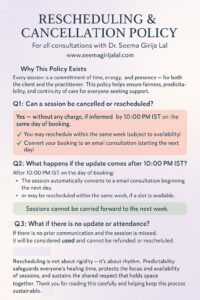
So, this poster, about rescheduling and cancellations, isn’t just a policy update. It’s a love letter to the boundaries that make care possible. A quiet reminder that valuing time is not greed. It’s grace.
