How Many Sessions Does It Take to Heal?
August 23, 2026
A question I hear in almost every first session is, "How many sessions will this take?"
My answer is usually, "I don't know."
That can be a scary answer for people. Many assume coming to a mental health space is exactly like going to a medical doctor. When you break a bone, a doctor tells you to wear a cast for a certain number of days. It is very quantifiable. You take a blood test, and you can see exactly what is high and what is low.
Reflective spaces do not work that way.
Thoughts, emotions, and changes in your nervous system are not easily measured. The timeline depends entirely on what is happening in your life and your daily capacity.
Figuring It Out Together
You are the one who decides the timeline. I do not hand out a set of instructions. We co-create the space.
When you share your journey, we figure out what you actually need in that exact moment. It is a constant balancing act between two spaces:
| The Approach |
What It Actually Looks Like |
| Validation |
You need to hear that your feelings make sense. You need a safe space to share and know you are not alone. |
| Reflection |
You need questions. You need to look at an event or a feeling from a different angle to move forward. |
Every person’s needs are different. And those needs can change from week to week.
The Gym Metaphor
When you ask how long it takes to get "healthy," think about going to the gym.
If you go to a personal trainer to work on physical fitness, you don't ask exactly how many days it will take to be fit for the rest of your life. You instinctively know it is a continuous practice.
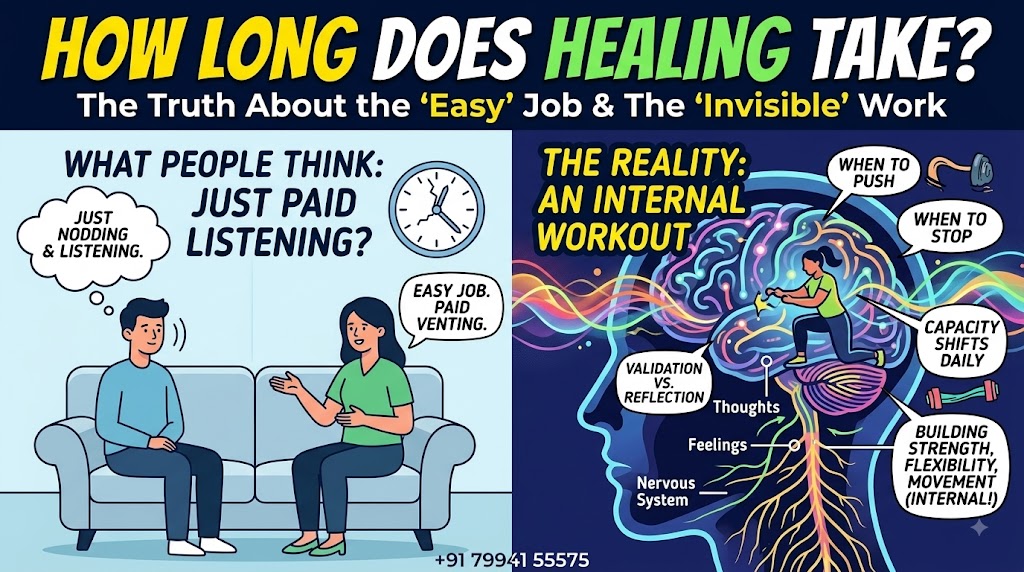
Our reflective work is the exact same thing. We are building capacity for your nervous system in three specific ways:
-
Internal Movement:
This is not physical movement you can see. When you talk about your lived experiences, your body starts moving internally. Your heart beats faster. Your throat feels choked. Even if you look perfectly calm on the outside, navigating this internal movement can feel like running a marathon.
-
Strength:
Like the gym, you cannot lift heavy weights on your first day. You start with what you can handle today. We slowly build the capacity to safely hold difficult thoughts and feelings without collapsing. This is built when we also learn when to put the weight down and , how long to hold , to regulate our breath alongside the holding.
-
Flexibility:
This is the ability to stretch and return to your baseline. You will get triggered in life. Flexibility means learning how to bounce back and find safety again.
The Invisible Work
The tricky part is that all of this internal movement is completely invisible.
Because it is invisible, people often think the work is easy. They say things like,
"It is just in your mind, just change your thoughts."
People even tell me I have an easy job. They say I just sit and listen. But holding space is a tightrope walk. Someone might sit in a session smiling and using humour, but internally, their nervous system is trembling. If we push with reflective questions too soon, they get triggered. We have to build safety first.
Trusting the Process
This is why I do not use rigid diagnostic models or clinical labels to describe my work. A diagnosis might give a broad framework, but it never tells the whole truth of a person.
Building nervous system capacity requires immense trust, open communication, and constant feedback. It is a slow process. It takes real effort to sit in these difficult spaces and do the work.
So, how many sessions does it take?
It takes as long as you need to build the strength, flexibility, and movement for your own life. And that lifelong practice is a deeply beautiful thing.

