
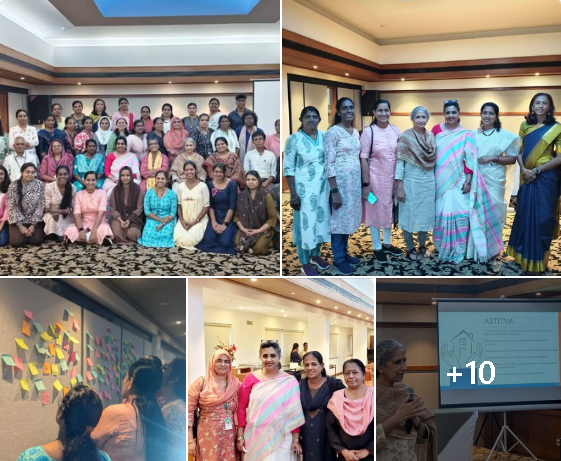
Day 2 held the image of a woman frantically asking for help to leave after repeated harm, urging the team to come before he returned. And still, when they reached her home, she was ironing his shirt for the next morning....also frantically! That moment said more than any workshop ever could. There’s no shortage of workshops or seminars. What continues to stay rare is work that remembers it has to live inside people’s everyday realities, not stay behind in the last session of a training. Over two packed days with frontline teams from eight districts - Ernakulam, Thrissur, Idukki, Pathanamthitta, Kollam, Trivandrum, Kottayam, Alappuzha, each group named specific actions they will take forward and actually report back on. CCRRA even opened WhatsApp groups so outcomes don’t vanish into the gap between meetings. Most teams leaned toward digitising processes so a woman is not forced to move from office to office retelling the same painful story, hoping someone will finally hold it with care. There were plans to publish DV helpline numbers widely, build district-wise directories of key responders, and explore partnerships with organisations that can strengthen support. The room also held deep admiration for the work PCVC Chennai has sustained for over two decades. What moved everyone was not the number of services, but the way care is offered, with dignity, clarity, and real choice. Do No Harm brought up difficult questions. Many wondered how someone overwhelmed and unsure can be given meaningful choice. That led to a conversation on how years of being told she is the problem erode the ability to trust her own judgement. Choice, then, begins with the smallest moments: A police personnel asking, “Would you like a five-minute pause and a glass of water, or are you ready to continue?” The investigation must happen, but the pace can still belong to her. A doctor explaining the examination step by step, checking if she needs them to slow down or pause. The procedure may be necessary, but the way her body is touched can still honour her safety. A community worker acknowledging when she says she wants to return home because her children are there, and asking, “Do you feel safe enough to return tonight, or would you prefer to stay at the shelter with your children until things settle?” For safety is a what she feels within. Helpers often carry the instinct to educate, correct, or persuade. But the reality of her life may be nothing like the imagined one. Capacity is not a moral flaw. Safety is rarely a simple yes or no. And even when she wants to return to a person who has harmed her, it remains her choice. What she needs is a message that she can reach out without being judged for not following advice, and without being abandoned for choosing differently. Many women already know exactly what is happening. Some have normalised harm because the alternatives - uncertainty, backlash, blame from children, and pressure from the entire system, feel heavier than the harm they live with. Some children replay the same script they grew up hearing: “He hit you because you provoked him.” This grows from a culture where hitting children for “discipline” is seen as acceptable, and hitting adults suddenly becomes an outrage. The learning and unlearning sit painfully close. Much of this rests in the CARE principles we revisited: Centre her voice, Avoid harm, Respect boundaries, and Strengthen her agency with practical routes to support. These are not lines on posters. They are daily practices that shape whether a survivor feels held or handled. Watching district teams move from discussion to decisions offered a sense of grounded hope as preparations begin for the next set of districts. Each room brought a mix of exhaustion and determination, and still left with plans that felt doable. Women often grow up learning to shape themselves to the spaces around them, to hold families steady, to adapt until adaptation becomes instinct. And then, when needed, to rise with the force of someone reclaiming their own ground. Flexing and flowing are not weaknesses. They are survival skills carried through generations. Here’s to more rooms that recognise that strength instead of demanding it. And to being born a woman, layered, tired, instinctively resourceful, and still choosing to rebuild, again and again.
