
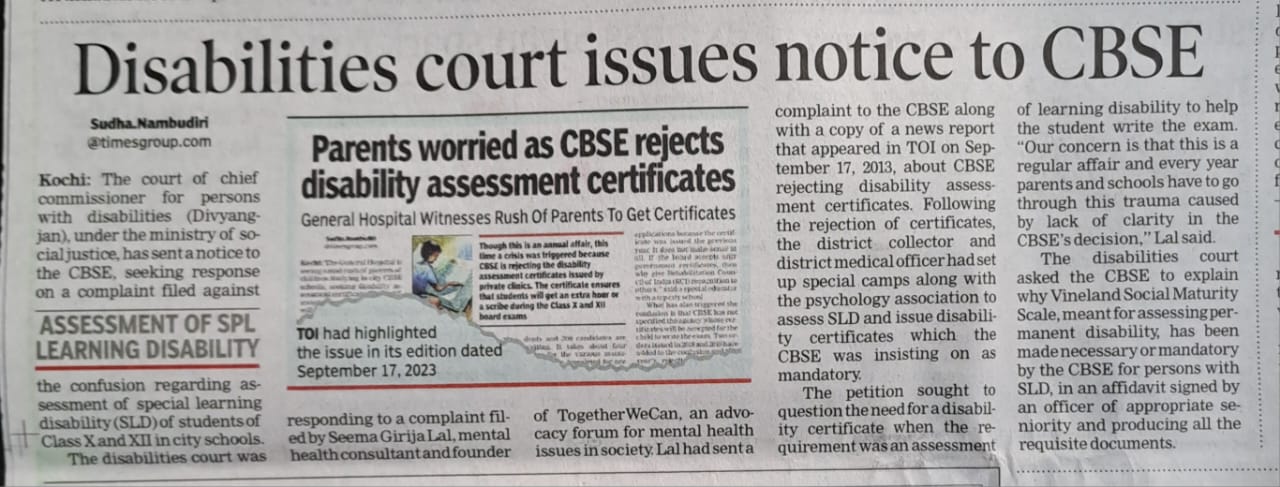
I am deeply grateful to Sudha Nambudiri for her continuous support in advocating for the rights of students with specific learning disabilities (SLD). In my recent article, I address a pressing concern regarding the assessment process for these students, particularly the discrepancy between the CBSE circular and the gazette notification from the Ministry of Social Justice and Empowerment. I want to highlight the misinterpretation of the gazette notification published in January 2018. It's important to note that the Vineland Social Maturity Scale (VSMS) is mandated only for students with intellectual disabilities (ID), not for those with SLD. The gazette distinguishes between ID (Section 21) and SLD (Section 22). The correct assessment procedure for students with SLD, as outlined in the gazette notification, includes observations and informal assessments by school principals and teachers, evaluations by pediatricians to rule out sensory impairments, and psychological assessments comprising either MISIC or WISC for children up to 15 years old, along with the NIMHANS battery of tests specifically designed for assessing SLD. I am concerned about the CBSE's insistence on VSMS for students with SLD, which not only violates the gazette notification but also imposes an unnecessary burden on schools, students, and their families, especially given the challenges posed by the ongoing pandemic. Regarding the requirement for re-certification within 18 months, it is necessary only if the student requires a permanent disability certificate. Subjecting students to re-certification within such a short timeframe, despite the comprehensive assessment process they undergo, adds further strain on them and their families. I also want to emphasize that the gazette notification does not stipulate that assessments must be conducted solely by government practitioners, contrary to the insistence of some stakeholders. There is a need for clarity and support from authorities to ensure that schools can effectively assist students in accessing their fundamental right to education without unnecessary hurdles. In conclusion, I urge policymakers and educational authorities to align their practices with the gazette notification, prioritize the well-being of students with disabilities, and provide clear guidance to facilitate their educational journey.
