
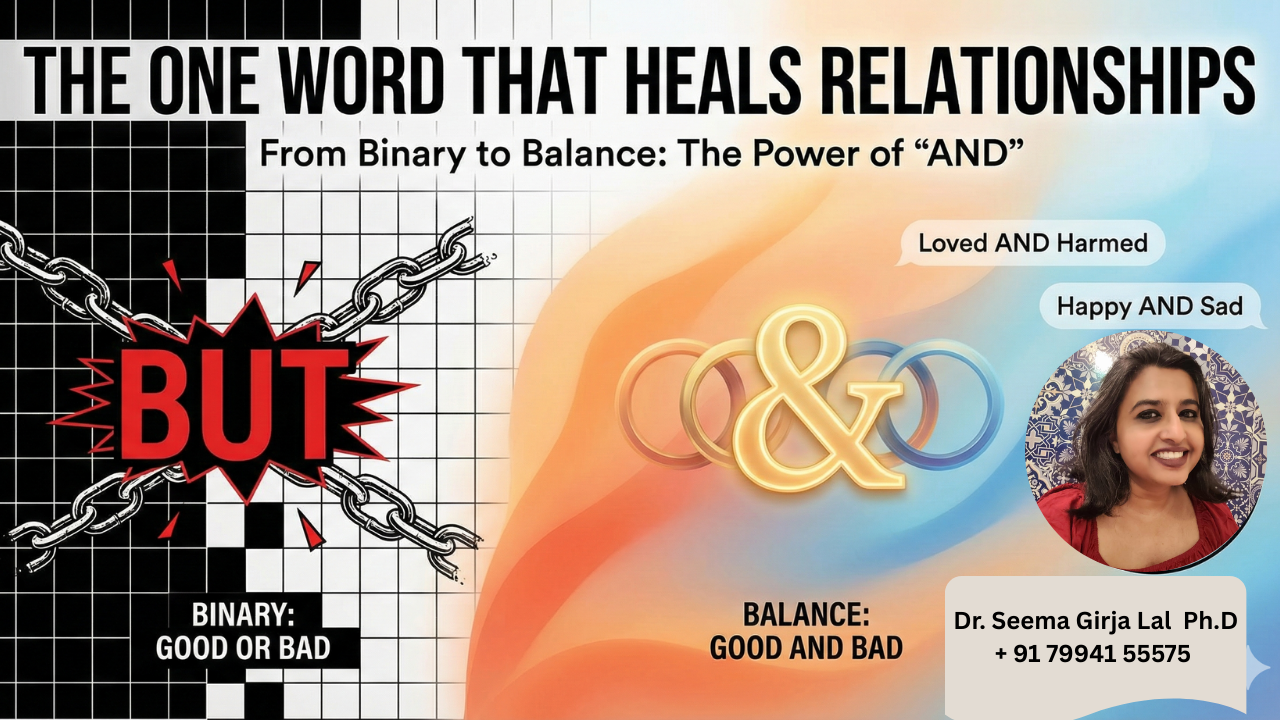
Let’s look at the architecture of our thoughts. For most of us, our training began early—at home and in school—within a strict system of Binary.
We lived in a world of clear instructions: Do this, Don't do that. We were given lists of Dos and Don'ts. In school, the binary was even clearer: you either Pass or you Fail. You are either a "Good student" or a "Bad student." You are "Disciplined" or you are "Naughty." There was very little gray area.
As children, we actually found safety in this system. It was predictable. Like math class, where one plus one always equals two, there was always one right answer. We could memorize it, pass the test, and feel secure. We knew exactly where the line was.
But as we grow up, we realize that life isn't simple math. Humans cannot be reduced to numbers, and our experiences are not always quantifiable. We are messy, we have layers, and we are deeply contextual.
To really heal and grow, we must move from that rigid "Black and White" mindset to something more flexible. We must learn to hold complexity.
The mark of our resilience as adults is our ability to hold diverse thoughts, diverse emotions, and diverse needs—all at the same time—without shutting down, lashing out, or collapsing.
It is the understanding that:
I can feel happy AND sad.
I can feel hopeful AND hopeless.
My sadness can exist right alongside your joy regarding the same event.
We have the capacity to witness this shifting landscape in our own minds, and give that exact same room to the people around us.
However, in my practice, I often see people struggling to hold this complexity. We struggle to hold two truths at once. Instead, we use a tiny, three-letter word that acts like a giant eraser.
That word is "BUT."
We use "BUT" to delete one reality so the other one can win. Think about a simple example like a rainy day. If I say, "It was raining heavily, BUT I had an umbrella," the word "but" pushes the rain away. It says, "The rain didn't matter because I was dry." It trivializes the storm.
Now, imagine we do this with human feelings. We often assume that if we feel one thing, we cannot feel the other. We ask, "How can I love them if I am angry?"The answer is that these contradictions are entirely possible. We can be angry and love someone at the same time. The love is directed toward the person; the anger is directed toward what they said or did.
However, when we use the word "BUT," we destroy this balance. We force a choice. If I say, "I feel angry, BUT I love you," I am effectively erasing my own anger to prioritize the bond. If I flip it and say, "I love you, BUT I feel so angry right now," I am allowing the anger to erase the love.When we use "BUT," we are playing a zero-sum game. Only one truth is allowed to survive.
We see this play out in our relationships constantly. It turns conversations into battles where we are fighting to be heard, yet erasing each other.
In a Marriage: One partner might say: "I know I shouldn't shout, BUT I feel so frustrated that you keep forgetting things." (Translation: My shouting doesn't count, your forgetting is the real problem.) The other fires back: "I know I forgot, BUT I feel unsafe when you scream like that." (Translation: My forgetting doesn't count, your reaction is the real problem.)Neither feels heard. Both are using "BUT" to invalidate the other.
In the Workplace: A manager says: "You did a great job on the project, BUT you were late." The employee hears the praise being deleted; only the mistake remains. In the Parent-Child Bond: Perhaps the deepest wound comes from how we use this in the parent-child relationship. A parent might say: "I was strict, BUT I did it because I loved you." (Using "but" to erase the impact of the harm.) The child might say: "I know you loved me, BUT you hurt me." (Using "but" to say the love wasn't enough to stop the pain.)As long as "BUT" is in the room, we are in a courtroom. We are arguing over which truth is valid.
So, how do we stop the war? We stop it by replacing "BUT" with "AND."
"AND" is the peacemaker. "AND" allows two contradictory truths to sit in the same room without fighting.
Let’s replay those scenarios:
Finally, let’s look at the parent and child. This is where the deepest healing happens. Imagine if we could stop fighting over whether it was "good parenting" or "bad parenting" and just hold the whole truth.
Imagine a Complete Relationship where the adult child can say: "Mom, Dad... I know you loved me, AND I know you harmed me." And imagine the parent, grounded and brave, saying back: "Yes. I loved you, AND I accept that I harmed you."If we can all accept this, the war ends. We don't have to label anyone as a monster or a saint. It is not just one voice taking up space.
Everything has space. Everyone has space. Every thought, every feeling, and every need matters.When we drop the "BUT" and embrace the "AND," we stop erasing each other, and we finally start meeting each other.
