Inclusion, Not Confusion: Clarifying the RCI Statutory Warning
July 2, 2025
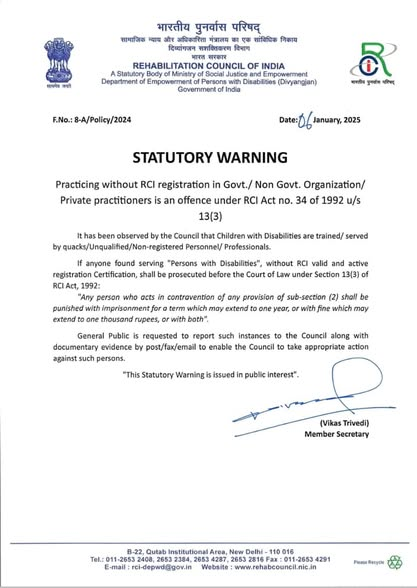
This statutory warning was issued earlier this year. Since then, many schools, educators, and parents have reached out for clarity. Though not an RCI member or representative, I share this from my experience in the fields of mental health, disability, and education.
Let’s not allow confusion to create more exclusion.
We already know of schools refusing admission to children with disabilities saying they’re “not equipped.” That itself is illegal. The RCI notice should not be used to justify this further.
Here’s what the law says:
“If anyone found serving ‘Persons with Disabilities’ without RCI valid and active registration Certification, shall be prosecuted…”
“Any person who acts in contravention of any provision of sub-section (2)...”
These sections clearly apply to clinical assessments, diagnoses, and formal therapeutic interventions. For those, an RCI license is required.
The intention is safety & regulation. But the impact, when misunderstood, has led to fear, withdrawal, and gatekeeping, especially in schools.
Let’s be clear: engaging with persons with disabilities, as teachers, facilitators, coaches, peers, is not a violation. You do not need an RCI license to relate, support, or include.
My own journey might help contextualise this. I completed an undergraduate degree in psychology, followed by coursework in Basic Neurodevelopmental Therapy with a special education core, and registered with RCI in 1999. I later completed a post-graduate degree in psychology and a PhD focused on vulnerability, agency, & empowerment, with a commitment to making lived experiences matter. Though trained in psychology and special education, I no longer function under the RCI license. I do not diagnose or offer therapy in the legal sense. I offer consultations, reflective sessions, and training, holding space for people to explore what blocks their agency, not to label or fix them.
A diagnosis may help some, it can validate, give language, identity, or provide access to entitlements. But not everyone wants or needs a label to know they’re struggling. Care must not be conditional on a diagnosis.
If we trusted people when they said they needed help, maybe we wouldn't need labels to prove pain. Everyone is eligible for support. We must hold space for both, those who want a diagnosis and those who don’t.
In every first consultation, I make this distinction clear. It’s not just about legal hygiene, it's about ethical clarity.
To schools unsure about non-RCI staff: unless someone is doing formal clinical assessments or offering diagnoses, they are not violating this law. Let them continue supporting students. If a diagnosis is needed, refer to a certified professional.
Let’s not confuse compliance with exclusion.
Let’s not build safety by adding more distance.
Let’s not gatekeep inclusion in the name of protection.
Inclusion needs clarity, not fear. And care must never be licensed out of reach.

