
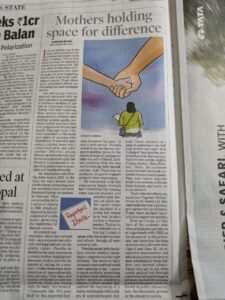
This morning, I woke up to a piece in The Times of India that felt less like a news report and more like a mirror held up to the last decade of our lives.
In her column, "Mothers holding space for difference," senior journalist Sudha Nambudiri captures something often missed in the noise of election years and policy debates: the quiet, relentless, and transformative labor of mothers. I want to take a moment to publicly thank Sudha. For over ten years, she has not just "covered" our stories; she has witnessed them. She has been an ally in the truest sense, ensuring that the narratives of families with neurodivergent children remain visible even when the world wants to look away.
The Journey of "Together We Can" Sudha’s article takes us back to where it all began—2015. It reminds me of the day a mother called me, distraught because her non-verbal child’s arm had been fractured during a therapy session. That single, heartbreaking incident shattered our illusion of safety. We realized there were no regulations, no accountability, and no "space" for us to question the medical models imposed on our children.That was the birth of Together We Can (TWC). What started as a small group of mothers—Preetha, Padma, Anita, and myself—huddled together in grief and anger, grew into a movement. We didn't set out to be activists. We just wanted our children to be safe. But as we peeled back the layers of systemic apathy, we found ourselves filing PILs, challenging the state, and demanding that "therapy" be redefined not as "fixing" a child, but as supporting a life.
From Activism to Academia: The Thesis This journey didn't just change laws; it changed me. It became the heartbeat of my doctoral research.My PhD thesis, "Making Lived Experiences Matter," was born directly from these battles. I realized that the "medical model" dismisses the one thing that matters most: the lived reality of the family. The data wasn't in the textbooks; it was in the living rooms of the mothers Sudha writes about.
The activism of TWC provided the evidence that mothers are not just "caregivers" to be instructed; they are the primary experts on their children’s lives. My research was an attempt to formalize what we knew in our bones: that neuroaffirming care cannot exist without co-creating knowledge with the families who live it.
Where We Are Now So, where are we today? As Sudha notes, the fight is far from over. We are still battling for basic accommodations, like the current struggle with the CBSE board for scribe permissions. The system is still slow, often exhausting.But something fundamental has shifted. We have moved from asking for permission to asserting our rights. We are no longer just fighting against bad practices; we are fighting for a world that values neurodivergence.
We are co-creating training modules (like the recent work with Nayi Disha) that center the community’s voice.
We are ensuring that "trauma-informed" isn't just a buzzword, but a standard for how we treat families.
We are holding space, not just for our children, but for each other.
Thank you, Sudha, for reminding us how far we’ve come. And to every mother "holding space" today: You are the movement.
