Open Conversation
July 5, 2025
Many of us struggle to balance power and connection because we've been culturally conditioned to believe we must choose one, either surrender ourselves for closeness or assert ourselves at the cost of warmth, when in truth, both can coexist.
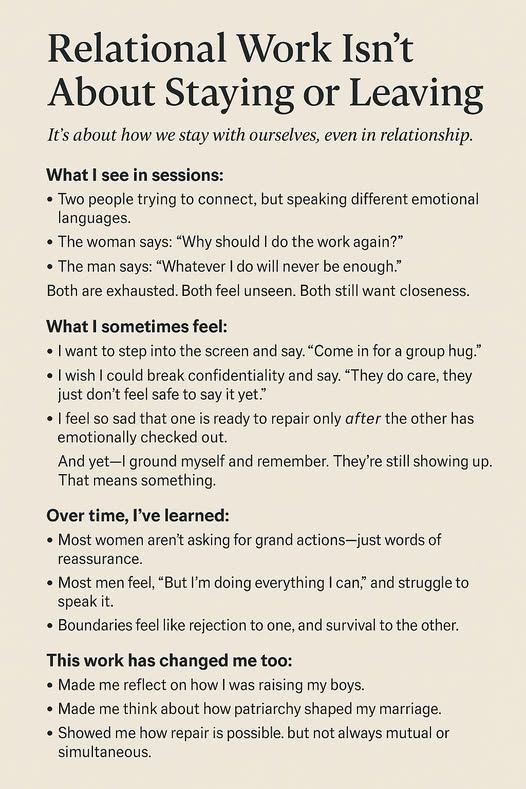
This insight lives at the heart of so many sessions. Couples arrive carrying not just unmet needs, but years of loneliness in togetherness. Both long for connection,but they’ve been speaking in different emotional languages for too long. Ever since consultations moved online in 2020, something changed. Men started reaching out, often individually. Not always with clarity, but with sincerity. Many arrived when their partners had already emotionally checked out. “Whatever I do will never be enough,” they say. “She keeps bringing up old things. I don’t know how to fix this.” And the women, by then, have carried the emotional weight for so long, they say, “Why should I be the one doing the work again?” And I sit with both. Sometimes, I want to climb into the screen and call them both in for a group hug. Sometimes, I ache hearing what one says privately, wishing I could tell the other, “They do care, they’re just not ready to say it yet.” And sometimes, I feel genuinely sad, because by the time one is ready to repair, the other has run out of emotional capacity. That lands heavily.
And yet, despite all of this, what moves me most is that they still show up. They return. They try. They hold space for themselves, even if not yet for each other. There are moments in sessions that have quietly helped me reflect on my own marriage too. Witnessing these stories reminded me how deeply men too are shaped by patriarchy,how emotional restriction gets passed down, normalized, absorbed. It made me pause, and reflect on how I was raising my boys. How patterns echoed across generations without us noticing.
In sessions, when NVC is offered, the woman often says, “Stop sugarcoating, I’m done being the giver.” And when boundaries are suggested, the man says, “That’ll just push us further apart.” Both are right. Both are protecting something tender. Often, she just needs words. Reassurance. A “You matter to me.” And he says, “But look at what I’m doing.” Then comes, “But look how she talks to me.” And so it continues. It’s rarely about the words or actions alone. It’s about meaning. Timing. Safety.
And in the middle of it all, no one is “the problem.” No one is broken. It’s just two people, carrying legacies, pain, longing, and trying to reach each other across a widening emotional gap. For me, success isn’t defined by whether they stay together or part ways. It’s when both find their ground again. When dignity, even in disagreement, becomes possible. When love becomes less about sacrifice, and more about sovereignty. When respect becomes non-negotiable, whatever path they choose. That is the work. And that is enough.

