Open Conversations; s this coping or choosing? My puzzle notifications got me thinking.
June 14, 2025
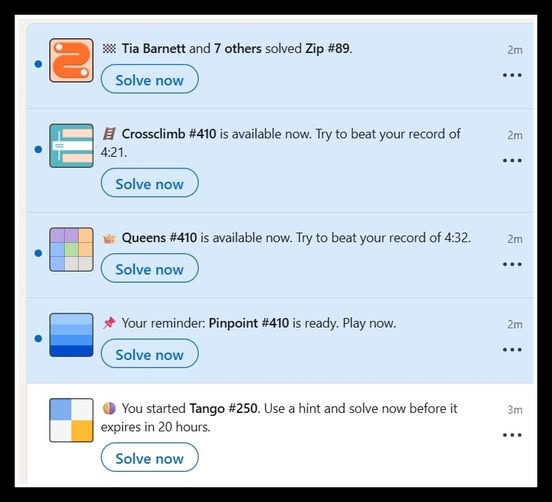
Is this coping or choosing? My puzzle notifications got me thinking.
This is how my screen looks between work sessions, games like Crossclimb, Queens, Pinpoint calling out to be played. I love these. Sometimes I solve one between sessions. Sometimes two...maybe even three.
But here’s the real insight:
It’s not about how many I play. It’s about why I’m playing.
Am I escaping something? Or am I consciously grounding myself so I can return more present, more connected?
There are moments a puzzle feels impossibly easy and still, I’m stuck, because I’m still holding residue from a deep client session. Solving lets me pause, breathe, and reset my nervous system. Sometimes I drop a game halfway and return to emails. Sometimes I sit with my thoughts instead. That’s how I know I’m choosing, not coping.
And if the game doesn’t "let me win"? No frustration. I walk away.
No algorithm can bait me with pixelated rewards I’m not chasing.
How do I know I’m not escaping?
* I can sit with my thoughts without distractions.
* I can walk away without craving a win.
* I have *other tools* I reach for too, writing, resting, walking, connecting.
* I don't play these while ignoring people or responsibilities.
* And most importantly, I reflect on how it lands in my body, before, during, and after.
Fifteen years ago, I wasn’t so conscious.
Back then, it was *Farmville and pink cows giving strawberry milk!! (yes, really). I played because I was overwhelmed, pregnant, lonely, and craving connection. I didn’t have words for what I was feeling, so I clicked. That was coping.
Today? I play not to disconnect but to come back to myself. To re-center.
It reminded me of a young client recently who sheepishly admitted, “I play games when I’m upset.” We laughed, and then unpacked what it meant. The shame melted when we added awareness and intention to the mix.
So, before labeling a behavior “addictive” or “bad,” ask:
What’s happening in your body?
What emotion is underneath?
Can you choose it… and can you also let it go?
We’re not always escaping. Sometimes we’re arriving, just in disguise.
Not all puzzles are distractions. Sometimes, they’re anchors.
What matters is: Are you running from, or coming back to, yourself?

