Open conversations ; Those Who Care Also Need C.A.R.E.
July 19, 2025
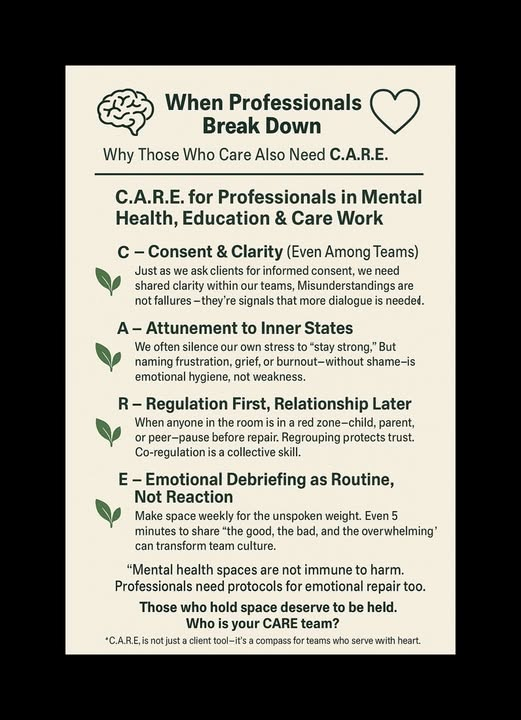
When Professionals Break Down: Why Those Who Care Also Need C.A.R.E.
In the helping professions, whether therapy, education, or care work, we often speak about regulation, dignity, boundaries, and emotional attunement. But we rarely pause to ask:
Who holds the space when we break down?
Who regulates the therapist, the educator, the caregiver, the frontline team member, when their boundaries are crossed?
Recently, I witnessed a situation where a team of skilled, compassionate professionals, deeply committed to child and family care, found themselves in the middle of an unexpected emotional rupture. A single logistical error, compounded by grief, unmet expectations, and an escalated confrontation, left a room full of professionals dysregulated and distressed. What stood out was not the rupture itself, but how deeply the team internalised guilt, shame, and helplessness, even when they had shown up with sincerity, responsibility, and care.
It reminded me of something vital:
Mental health spaces are not immune to harm. Even professionals need protocols for emotional repair. Even caregivers need care.
This is where I turn to the C.A.R.E. acronym, not just as a client-facing model, but as a team-sustaining compass.
C – Consent and Clarity (even among professionals)
Just like we ask clients for informed consent, we must extend clarity and ongoing check-ins within teams. Misalignment in goals or language isn’t a flaw, it’s a signal that more dialogue is needed.
A – Attunement to Inner States
Professionals often bypass their own emotional responses in the name of “being strong.” But attunement starts within. Naming frustration, grief, burnout, or confusion without shame is an act of emotional hygiene.
R – Regulation First, Relationship Later
When someone in the room is in red zone, be it a child, a parent, or a colleague, relating becomes difficult, and reasoning may rupture trust. We need to build the collective muscle of pausing, regrouping, and modelling co-regulation.
E – Emotional Debriefing as Routine, Not Reaction
What if every team had 30 minutes a week to share the “unspoken weight” of the work? Not as therapy, not as supervision, but as emotional hygiene. A 5minute turn to share “the good, the bad, and the overwhelming” could change everything.
This post is not about one team or one event, it’s about the emotional toll of being in the service of others. And how even the most intentional professionals need systems of care, not just checklists or trainings, but spaces to feel, falter, and heal.
If you're a leader, educator, therapist, or care provider:
Where do you go to regulate, relate, and reflect?
Because those who hold space need to be held too.

