Open Conversations ; Why Emotional Literacy, Not Just Emotional Intelligence?
June 21, 2025
Why Emotional Literacy, Not Just Emotional Intelligence?
Emotional intelligence is about using emotions wisely, navigating social cues, solving problems, and managing relationships.
That’s great… for adults.
But preschoolers? They’re not there yet.
They don’t need emotional IQ.
They need emotional ABCs.
So what is emotional literacy?
It’s learning to:
• Recognize what they’re feeling, starting in the body.
• Understand that feelings aren’t bad—they’re messengers.
• Label those feelings with words.
• Express them safely.
• Regulate with support, not shame.
Why do we call it literacy?
Because, like learning to read, emotional literacy develops step by step:
• From letters (body sensations)
• To words (named emotions)
• To sentences (safe expression)
• To stories (meaning and understanding over time)
Emotional Hygiene like Toilet Hygiene
Think of emotions like the need to go to the toilet:
• It starts as a body signal (a pressure or sensation).
• The child may not know what it is or what to do with it.
• They need help recognising the signal, learning how to respond, and finding a safe place to release.
• They’re not born knowing how to wipe, wash, or clean up afterward.
• Just like toileting, emotional release needs gentle teaching, privacy, no shame, and repetition.
We don’t punish children for needing to pee, we guide them.
We can do the same with their emotions.
Imagine a child who just came back from a loud, busy birthday party at school.
The balloons popped, the music blared, the icing was too sweet, and everyone wanted the same toy.
At home, she screams because her socks feel “weird” and throws them across the room.
It seems like an overreaction. But what’s really happening?
She’s not being “naughty”—she’s overloaded:
• Sensory overload (noisy party, itchy socks)
• Emotional overload (excitement, social tension, unmet expectations)
• Cognitive overload (too many choices, too much change)
What she needs is not scolding or logic.
She needs help LISTENing to what her body and feelings are saying.
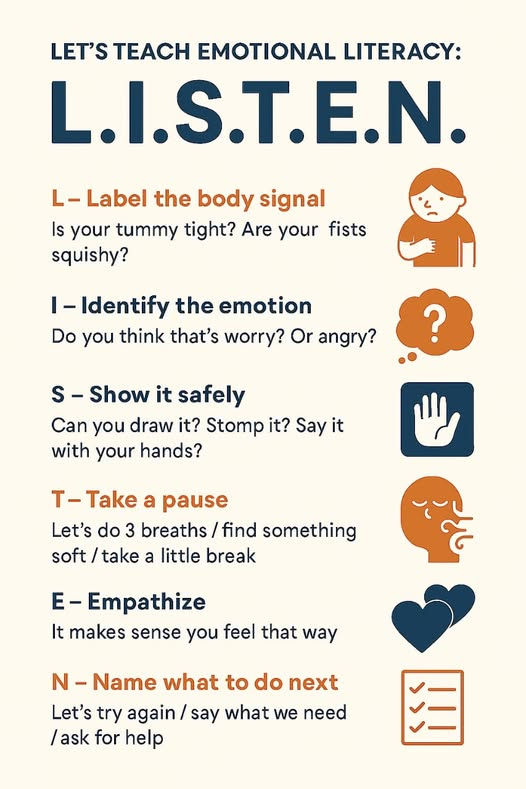
L.I.S.T.E.N. —for Emotional Literacy
Let’s help children LISTEN to their emotions, just like we help them learn letters and sounds:
L – Label the body signal
“Is your tummy tight? Are your fists squishy?”
Like noticing you need to pee—your body speaks before your brain does.
I – Identify the emotion
“Do you think that’s worry? Or angry?”
Like saying, ‘I need the bathroom’ instead of just dancing around. It connects the feeling to a word.
S – Show it safely
“Can you draw it? Stomp it? Say it with your hands?”
Like finding the toilet in time, instead of having an accident—it’s about safe release.
T – Take a pause
“Let’s do 3 breaths / find something soft / take a little break.”
Like sitting quietly on the potty—you need space and calm for it to happen.
E – Empathize
“It makes sense you feel that way.”
Like saying, “It’s okay. Accidents happen.”—no shame, just care.
N – Name what to do next
“Let’s try again / say what we need / ask for help.”
Like learning to flush, wash, and move on—it’s about completion and moving forward.
Why "L.I.S.T.E.N."?
Because emotional literacy isn’t about controlling children.
It’s about teaching them to listen to their bodies, trust their feelings, and connect meaningfully with others.
We’re not just raising kids who follow instructions, we’re nurturing humans who can read their inner world and respond with care.
Just like we teach them to read books, we teach them to feel.
Step by step. Softly. Repeatedly.
So next time your child has a meltdown…
Don’t rush to fix it or label it as misbehaviour.
Help them LISTEN.
Because behind every big feeling is a little person learning how to be in their body and in the world.

