
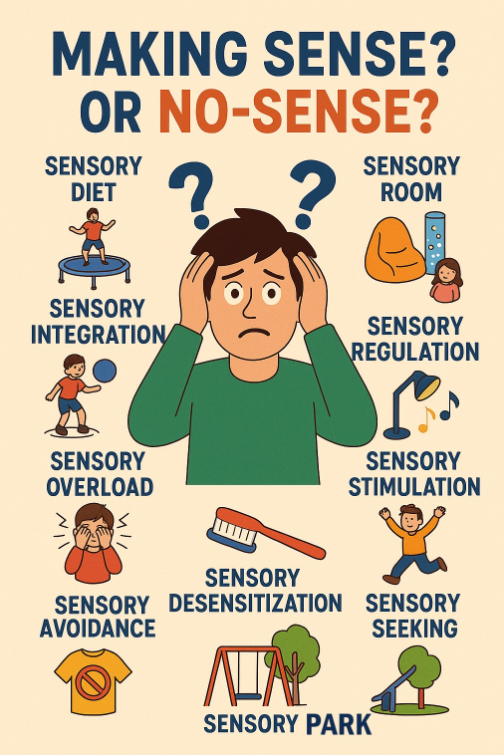
#OpenConversations #MakingLivedExperiencesMatter Some days it feels like the whole world has suddenly discovered the word sensory and now everything from trampolines to beanbags to parks to toothbrushes is labelled with it. Parents hear sensory diet, sensory room, sensory overload, sensory seeking, sensory avoidance, sensory integration, sensory desensitization, sensory regulation, sensory stimulation, and sensory park, and no one stops to explain what any of it actually means. It can feel like a private language with high stakes, especially when everyone is trying their best to support a child who is struggling but still wants to feel understood, respected, and safe. At its core, sensory simply means the way a body gathers and responds to information. Light, sound, touch, smell, taste, movement, balance, and the internal signals that tell us what is happening inside the body. When these systems work smoothly, everyday life feels easier. When they don’t, things that look “small” from the outside can feel huge from the inside. A sensory diet is one of the most misunderstood terms. It is not random jumping or squeezing or swinging just because the activity looks sensory. It is a thoughtful plan that fits the child’s nervous system on that day, at that moment. A child running from the table to jump is not a diet. An adult insisting on trampoline time when the child’s body needed deep pressure or slow swinging is also not a diet. A diet works only when the activity actually regulates the child and connects to what comes next. A sensory room is not any room with fairy lights. It is a space designed for regulation, not a place where a child is sent alone with the hope that the environment will do the work. A sensory room needs engagement, choice, comfort, and safety. Without these, it becomes just another overstimulating corner. Sensory integration is active. It happens when the brain is coordinating and organising input into meaningful action. Watching someone swing is not integration. Lying on a beanbag is not integration. Integration is the child moving, balancing, timing, adjusting, coordinating, and making sense of what their body is doing. Sensory regulation is the body’s way of staying within a manageable range. It is not forced calm. It is not “stop crying.” It is listening to the body and giving it tools to return to a sense of safety. A child covering their ears or asking for pressure is regulating. A child being told to behave while overwhelmed is not regulating; it is coping without support. Sensory overload is not drama or misbehaviour. It is the nervous system saying “this is too much.” Loud malls, bright lights, sudden sounds, unpredictable environments can tip a child into shutdown or distress long before the adults around them notice what is happening. Sensory stimulation can support regulation or completely derail it. One child calms with deep pressure. Another becomes more distressed. One child wakes up with spinning. Another gets dizzy and frightened. Sensory input is personal, and one person’s soothing is another person’s overwhelm. Sensory avoidance is not fussiness. It is a survival strategy. A scratchy shirt, a strong smell, a loud room can feel physically painful. Forcing a child to tolerate it does not build resilience; it builds fear. Sensory seeking is also not mischief. It is a need for more input to feel centred. When movement, deep pressure, touch, sound, or texture help the body stay organised, seeking becomes the nervous system’s way of staying connected. Sensory desensitization is not pushing a child to “get used to it.” It is slow, consent-based exposure that respects the child’s pace. The nervous system learns only when it feels safe. A sensory park is designed intentionally. A regular playground might have swings and slides, but not textures, water play, balance paths, quiet corners, or spaces that support a range of sensory needs. A sensory park welcomes many kinds of bodies and nervous systems and creates room for exploration without pressure. All these words matter because children experience the world through their bodies before they can explain it through language. Understanding sensory patterns is not about fixing a child. It is about noticing what their nervous system is saying long before behaviour becomes the only way they can communicate it.
