SAFE VOICE: Understanding the Silence Around Abuse
September 1, 2025
This is one of the most feared questions survivors of abuse hear. On the surface, it may sound like curiosity. Beneath it, it carries blame. Survivors sense it instantly and often stay silent even longer out of fear of hearing it. The longer the delay, the heavier that question becomes.
To understand why, we need to see how silence unfolds.
The shock of the first violation
Abuse often comes not from strangers but from people we know: a colleague, a mentor, a family member, a friend. Sometimes even through social media messages or group chats that turn unsafe. When the first violation happens, the body reacts instantly, stomach twisting, throat closing, heart racing.
The nervous system screams, “Boundary crossed.”
Yet the mind whispers back, “Maybe I misunderstood. Don’t make it a big deal.” This is not indecision; it is the brain’s attempt to soften unbearable shock with self-doubt.
The spiral of self-doubt and guilt
In the days that follow, the moment is replayed endlessly. Am I exaggerating? Did I invite this? When it happens again, silence grows heavier. Shame and guilt settle in, even though responsibility lies only with the one who caused harm.
When disclosure finally comes
Speaking up is rarely about a single event. It is about many moments, piled up over time, whether in physical spaces or online. To outsiders, this can look like a pattern the survivor “allowed.” That is when the most damaging responses appear: “So you encouraged it? Maybe you enjoyed it. If it was real, you would have told earlier.” These words cut deeply because they echo the doubts survivors have already been battling silently for months or even years.
Why silence lingers: the SAFE VOICE framework
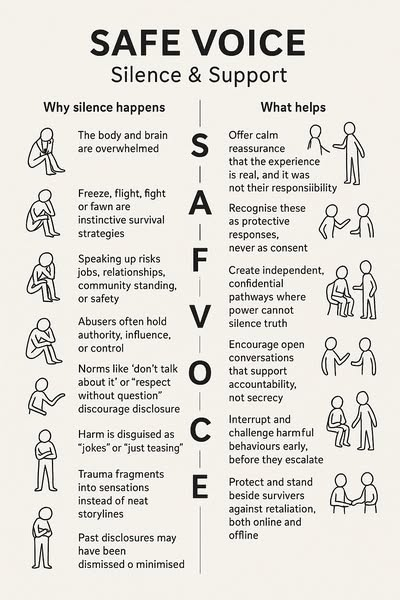
Silence is not weakness. It is survival. The SAFE VOICE framework shows how silence builds, and what can help create the safety needed for speech.
S – Shock
Why silence happens: The body and brain are overwhelmed, struggling to process the first violation.
What helps: Offer calm reassurance that the experience is real, and it was not their responsibility.
A – Adaptive survival
Why silence happens: Freeze, flight, fight, or fawn are instinctive survival strategies, not choices.
What helps: Recognise these as protective responses, never as consent.
F – Fear of consequences
Why silence happens: Speaking up risks jobs, relationships, community standing, or safety.
What helps: Build systems where reporting is safe and does not cost survivors their stability.
E – Entrenched power
Why silence happens: Abusers often hold authority, influence, or control.
What helps: Create independent, confidential pathways where power cannot silence truth.
V – Voices of culture
Why silence happens: Norms like “don’t talk about it” or “respect without question” discourage disclosure.
What helps: Encourage open conversations that support accountability, not secrecy.
O – Ongoing normalisation
Why silence happens: Harm is disguised as “jokes” or “just teasing,” making abuse harder to name.
What helps: Interrupt and challenge harmful behaviours early, before they escalate.
I – Incomplete memory
Why silence happens: Trauma fragments into sensations instead of neat storylines.
What helps: Believe survivors even if memories come in pieces or over time.
C – Consequences of retaliation
Why silence happens: Survivors risk harassment, exclusion, or further harm if they speak.
What helps: Protect and stand beside survivors against retaliation, both online and offline.
E – Erosion of trust
Why silence happens: Past disclosures may have been dismissed or minimised.
What helps: Respond with consistency, belief, and care, every single time.
A better question to ask
Instead of “Why didn’t you tell earlier?” we can ask:
“What helped you feel safe enough to tell now?”
or
“What do you need from me to feel supported?”
These questions shift the focus from blame to care. They honour disclosure itself as an act of courage, no matter when it happens or whether the violation took place in a home, a classroom, a workplace, or a text message.
Closing reflection
Silence is not avoidance. Delay is not dishonesty. It is a response to unsafe conditions. Survivors are not to blame for waiting. The responsibility for change lies with those who cause harm, and with all of us to build systems of accountability, care, and safety.
The real question is not “Why didn’t you tell earlier?”
The real question is: “Now that you’ve spoken, how can we hold you with safety and care?”
Our voices, whenever they come, matter. And none of us are alone.

