
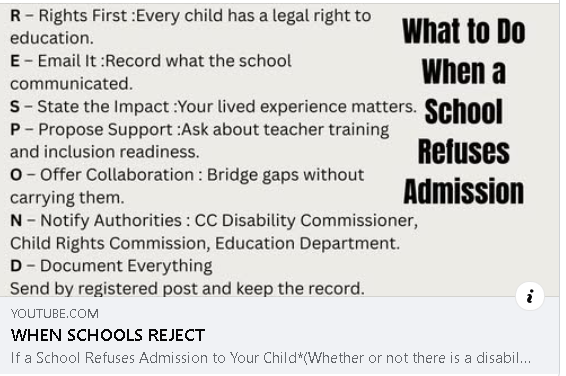
Schools still turn children away. Some do it openly, some do it in polished language, and some do it in the “we are not equipped” script that parents across the country hear far too often. This happens whether a child has a disability certificate or not. For children below 14, the law is clear: admission into an age-appropriate class is a right. No certificate is needed. No assessment is needed. No screening is allowed. This rule exists so that schools cannot gatekeep childhood itself. Yet families face rejection the moment a teacher notices the child is different, learns differently, moves differently, or communicates differently. For children above 14, the situation plays out in familiar lines. A school says the child may not cope, or the school may not cope, and none of this is based on any assessment. Most of it comes from a knowledge gap about disability, a skill gap among teachers who were never trained, and a support gap inside a system that asks for inclusion without building capacity for it. These gaps are real, but they are not the child’s burden to carry. Schools are responsible for filling them. Parents can still take steps that honour their rights and keep the conversation rooted in dignity. An email to the school helps record what was said, how it felt, and why it concerns the family. The reasons the school gave can be restated plainly, not to shame anyone but to note the experience. Parents can ask whether the school is aware of its responsibilities under the RTE and RPWD Acts. They can ask whether the school is willing to train teachers, update their practices, or accept support for peer education or staff sensitisation. Offering collaboration does not mean carrying the entire load; it means showing that families are doing their part even when institutions fall short. Such emails can be marked to the Disability Commissioner, Child Rights Commission, Education Department, and any other relevant authorities. They can also be sent by registered post so that the record stands even if the school chooses not to reply. This documentation becomes important evidence for systemic reform later, and it helps the next family who will face the same wall. Choosing not to return to that school is valid. Many parents make that choice. A school that publicly says it lacks the knowledge or skill to support a child tells the family everything they need to know about the learning environment. Still, sharing the experience makes visible what continues to be dismissed in private corridors. This is not about punishment; it is about change. It is about asking the system to grow so that children do not carry the cost of institutional unpreparedness. Rejection does not have to end the story. It can restart the conversation, expose the gap, and build pressure for real inclusion. We can hold the line for our children, and we can hold it together. https://youtu.be/l5yxj8c8bl4?si=KMMoK7-tR3N0Ntel Audio Malayalam
