
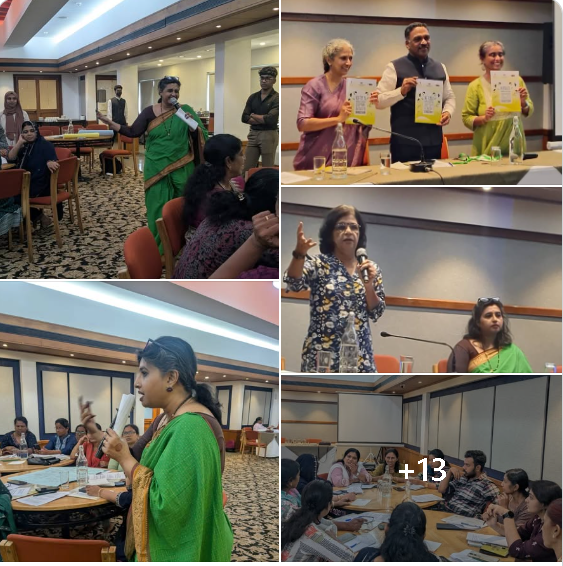
Day one left the room heavier and clearer at the same time. Sharing space with veterans of the field, the women police officers, the para-legal workers, counsellors, community social workers, and the unseen warriors who sit with survivors long before any policy catches up, has a way of rearranging what “expert” even means. The workshop was meant to be a space to teach, but the learning kept happening in both directions, almost stubbornly so. One person introduced themselves and suddenly the entire room was awake. Fierce voices, fierce questions, debates that refused to stay polite just for the sake of politeness, and a kind of collective honesty that only happens when everyone in the room has watched/lived how hard it is for a survivor to navigate multiple departments that refuse to talk to each other. And this refusal wasn't stubbornness. It came from each unit already working far beyond its limits. Everyone is stretched thin, and the survivor ends up running between systems that simply don’t have the bandwidth to fit together. And there I stood as the speaker for “Capacity Building.” The irony wasn’t lost. What capacity could possibly be built in people who are already carrying more than they should? The LENS activity did what it was designed to do. A single story, four characters, and the question of who could have prevented the abuse. The responses were revealing and contradictory and deeply human, and no one was exactly wrong. Some justified their pick with quiet conviction, others defended theirs like they were defending a thesis. The best part was watching them catch their own assumptions in real time, because learning does not always arrive gently. It walks in and taps on the shoulder mid-sentence at times and sometimes a face palm moment. SAFE brought another layer of truth. Safety is rarely about physical safety alone. It is often hidden inside the first question a helper asks, the tone, the silence, the pace. The groups wrote down the words that harm and the ones that hold someone steady, and the chart papers filled up faster than expected. It was unsettling in the best way. The kind of discomfort that teaches. There was laughter too, the kind that leaks out between intense conversations. Hard topics create their own strange camaraderie. Tomorrow brings the trolley analogy, deeper exploration, more unlearning, and probably more of that quiet collective courage that ran through the room today. The connection with PCVC continues to feel like a long-standing thread, nearly twenty-five years strong, and still weaving new connections. And listening to the judge speak with humility in a room full of frontline workers was its own education. Not many in positions of power speak openly about unlearning their own patterns. That takes a different kind of courage, the kind this work desperately needs. Hard day, important day, and a lingering sense of wanting to meet these fierce women again first thing in the morning.
