
Imagine purchasing a state-of-the-art smartphone. It possesses incredible capabilities and runs brilliantly. The only catch? A firm decision is made to never plug it in to charge. It is simply allowed to run, day after day, until the screen goes completely black.
It sounds entirely absurd right? Electronics are granted an immense amount of grace and receive downtime by carefully placed in 'low power mode.' Yet, when it comes to human bodies, those vital low-battery warnings are often completely ignored, and sometimes, ignoring them is even rewarded with a newspaper feature!!
A recent article celebrated a 14-year-old student for having zero absences from kindergarten all the way to 12th grade. First, the joy this student found in friendships, sports, and art festivals is entirely valid. Finding an educational space that feels safe and naturally engaging is a beautiful thing, and those lived experiences matter deeply.
The narrative surrounding this achievement, however, requires a pause.
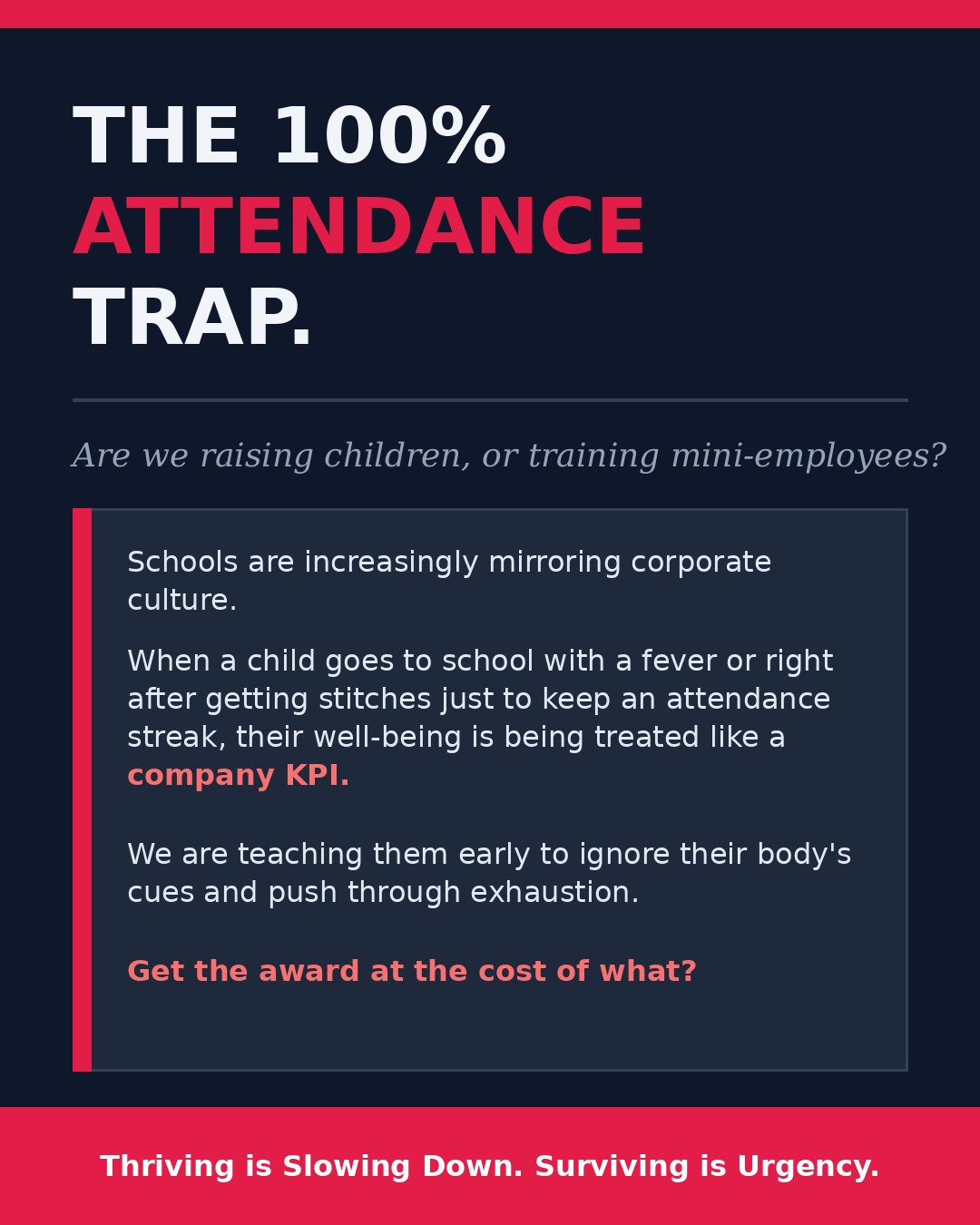
The article proudly highlighted attending school with fevers. It shared that after a bad fall requiring stitches, the primary fear wasn't about the body healing, it was about breaking the attendance streak. The streak, essentially, became more important than the stitches.
Picture this exact standard applied to an adult setting:
If a workplace demanded attendance the morning after an employee received stitches, it would be instantly recognized as a deeply toxic environment.
If someone insisted a partner cook and clean while running a severe fever, there is a clear word for that: abuse.
Demanding a human body to perform when it is practically begging for rest is universally understood as harmful.
So, a profound question arises to ponder: Why is this exact same standard celebrated as an ultimate achievement when it happens to a teenager? What exactly is being showcased to the next generation?
The most exhausting, burnout-inducing parts of corporate culture are essentially being placed onto the shoulders of a 14-year-old. The lesson being modeled is clear: ignore the body's cues. Push forward, no matter the physical cost.
The article mentions the student's mother, a teacher, maintains a similar record. This deserves deep compassion. Adults are often merely surviving in systemic environments that demand this exact, breathless urgency. However, it perfectly illustrates how these expectations are naturally absorbed across generations. When adults consistently prioritize performance over recovery, the unspoken lesson is that worth is strictly tied to uninterrupted presence.
In consultations and reflective spaces, this is exactly the kind of conditioning that requires gentle, profound unpacking. Relearning how to listen to the nervous system's signals is essential work.
Surviving looks like a frantic urgency to perform. It looks like the panic of breaking a streak.
Thriving, on the other hand, requires slowing down. It means making slow, gently informed choices about what the body actually needs in the present moment.
If this relentless standard is unacceptable for adults, it cannot possibly be the gold standard for children. Getting the perfect attendance award comes at what cost? Perhaps slowing down, honoring the body's natural signals, and taking the guilt-free time to simply plug into the charger are actually the most remarkable achievements of all.
