






Creating Safe Connection: Navigating the Emotional Waves of the Preschool Years
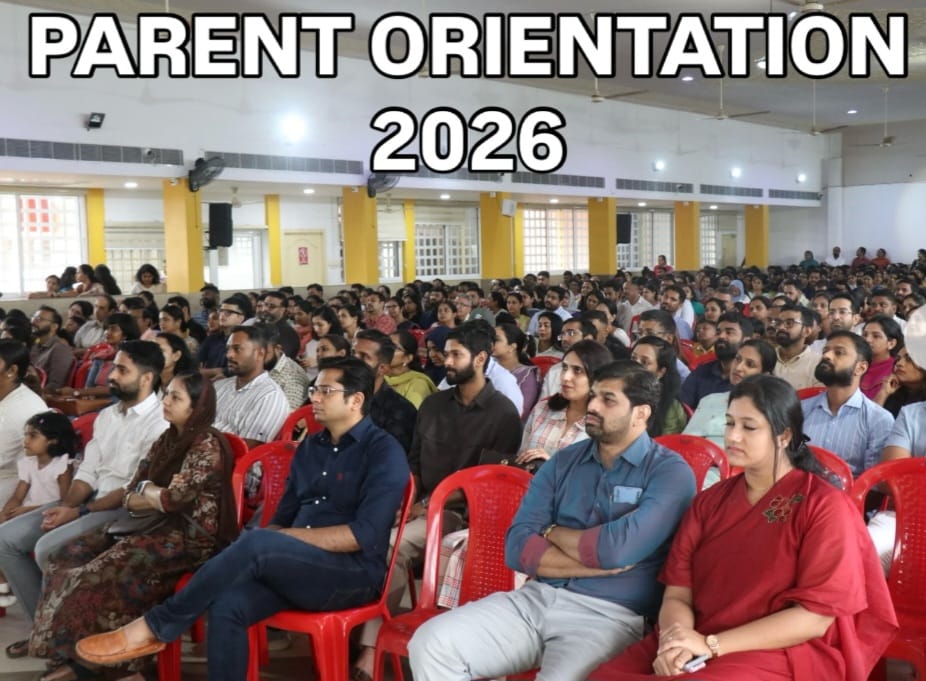
It takes immense effort, energy, and intention to look inward and observe how our internal world reacts to what is happening around us. Recently, I had the privilege of facilitating a session at Rajagiri Public School, Kalamassery. Seeing a massive auditorium filled with mothers, fathers, and grandparents spoke volumes. It highlighted not just their commitment to looking inwards while raising their children, but also the dedication of the educators and administration who facilitate these reflective spaces and encourage open, engaging conversations.
A special note of appreciation goes to the new head of preschool, Ms. Sajini Susan George, who embodies the concept of continuous growth and inward reflection. Regardless of her achievements, she approaches her role with curiosity and a profound openness to learn. The Father Principal's opening remarks set the perfect tone: it is not our qualifications or degrees that define us, but our willingness to learn, unlearn, and relearn that helps us grow.
The most rewarding part of any consultation is the interactive phase. The enthusiastic parent group at Rajagiri asked poignant, relatable questions that highlight how we are all continually learning alongside our children:
Navigating Public Spaces: How do we support a preschooler who experiences meltdowns in public or social settings, but is completely regulated at home?
Screen Time and Schoolwork: How can we manage screen time when the school shares necessary digital work, ensuring we prevent reliance on screens?
Repair and Reconnection: Having heard this information, I feel I could have done things differently with my older child. What can I do to reconnect now?
Honoring Pacing: My child is hesitant in groups and clings to me when guests visit or we go out. How can I support them in feeling comfortable without forcing interaction?
These questions showcase a universal truth: the ways we navigated preschool a decade or more ago are not the same ways parents navigate it today.
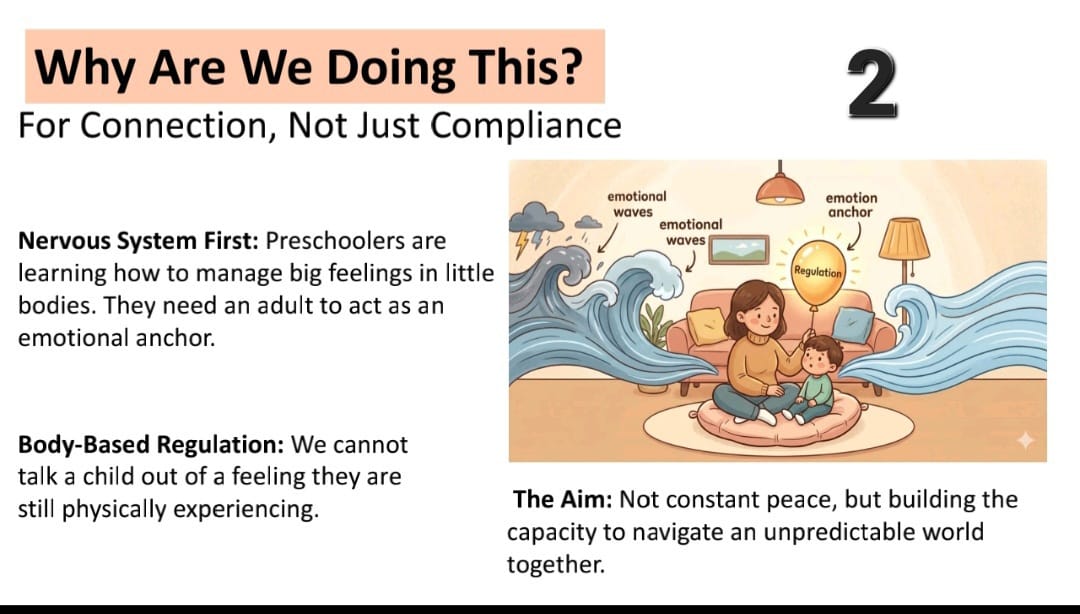
Beneath every interaction is how our nervous system processes information. With eight sensory systems constantly taking in data, we must first feel safe within our bodies. Only when a child feels secure, loved, and trusted can they be open to learning, unlearning, or relearning.
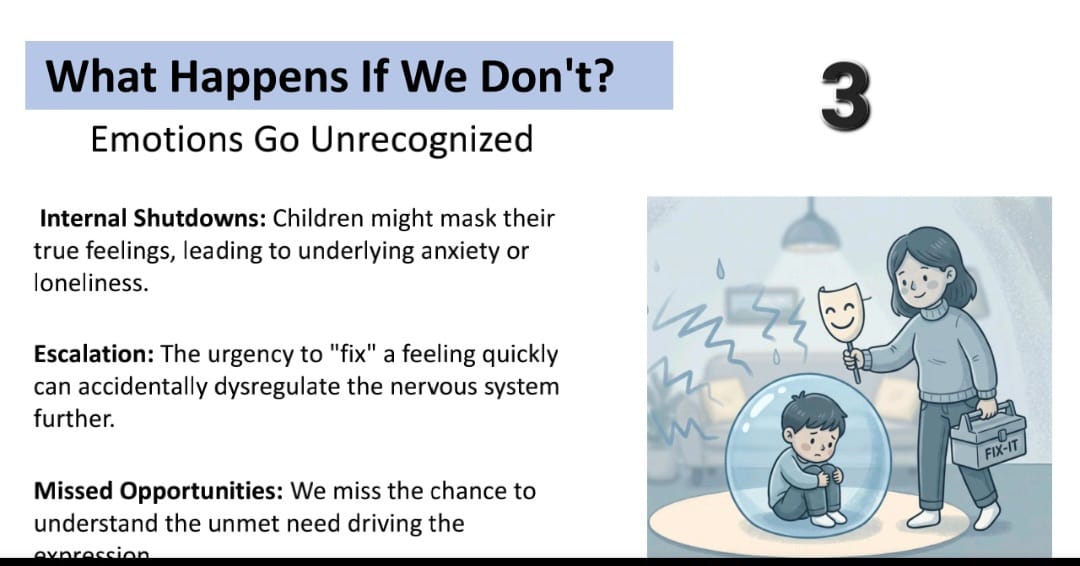
This process starts with adults modeling emotional safety. Often, emotional dismissal starts early—when a parent tells a crying child "don't cry," or a teacher tells an anxious student "don't be anxious." This immediate dismissal of feelings teaches children to lose trust in their own lived experiences.
What we can do instead:
Listen to them intently.
Hold them close and sit with them.
Allow them to release the energy of their emotions.
Be a consistent, safe space for them to process.
Preschoolers are in a stage of rapid emotional development, often characterized by intense "waves" of feelings that can overwhelm both the child and the adult. Behavior is always communication. Every "no" or meltdown is a request for connection or a sign of an unmet need. Because we cannot talk a child out of a feeling they are still physically experiencing, body-based regulation must come first.
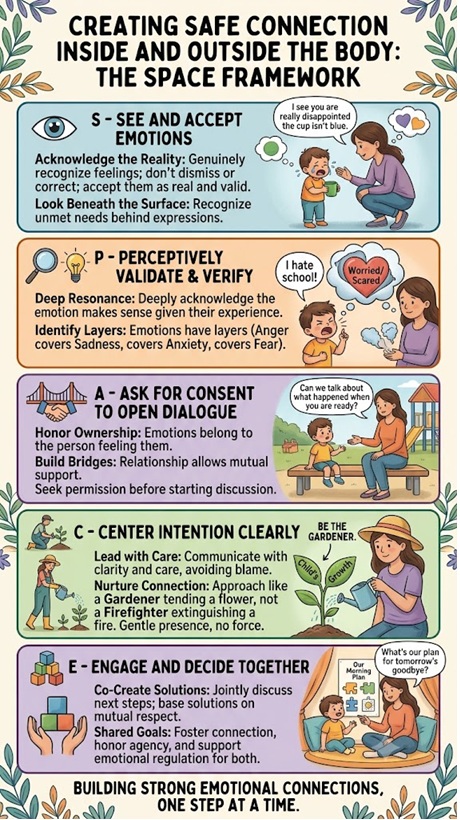
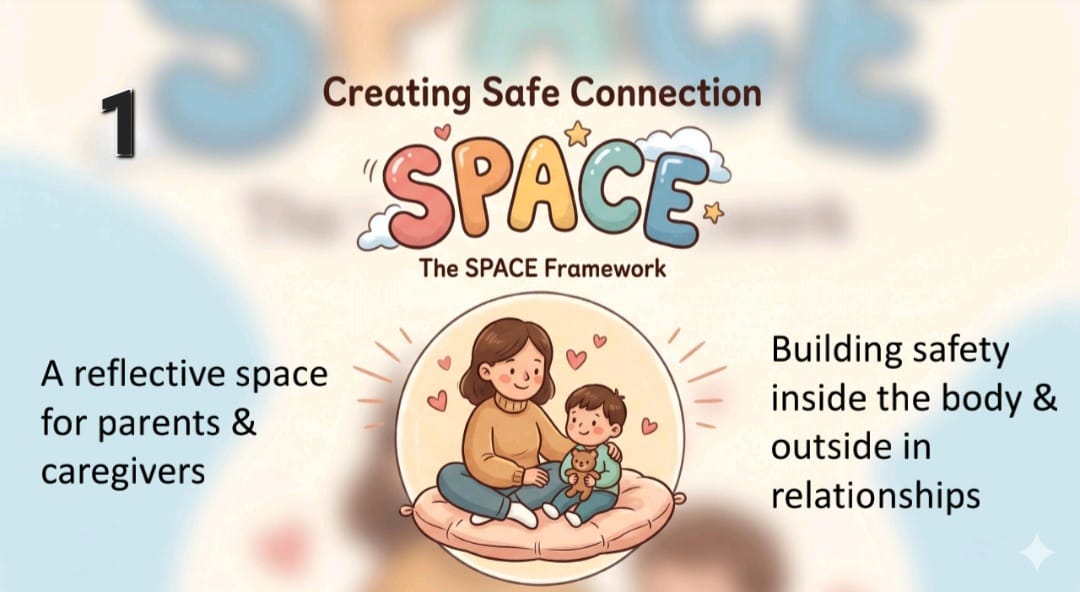
The SPACE Framework is designed to help adults act as emotional anchors, building a bridge of safety between your heart and theirs.
| The Framework | The Concept | Practical Application |
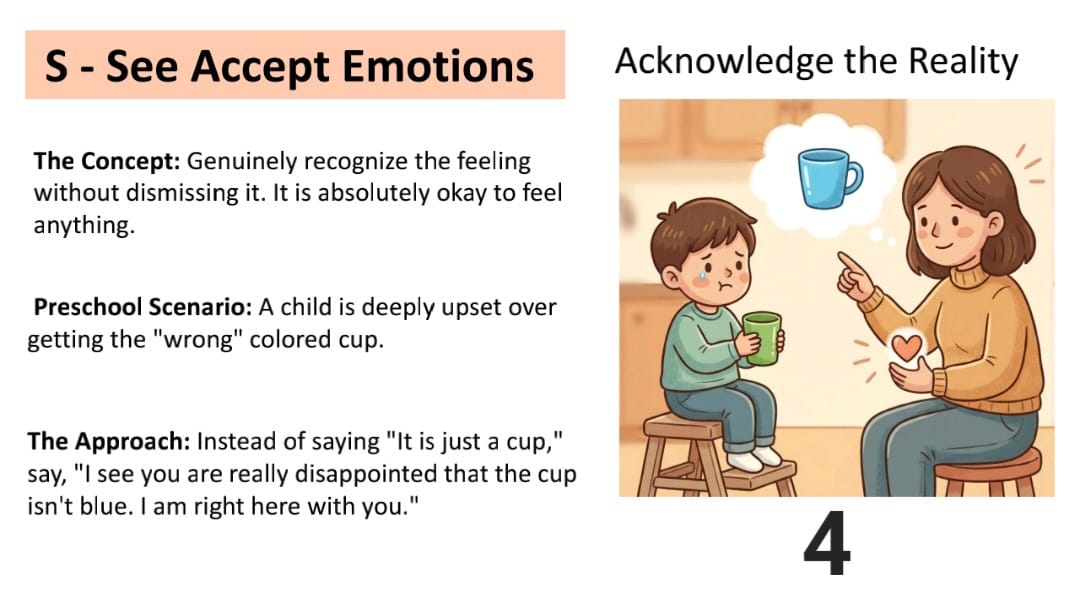
| S - See and Accept Emotions | Genuinely recognize feelings without dismissing or correcting them. Accept them as real and valid. |
Scenario: A child is upset over the "wrong" colored cup. Approach: Instead of saying, "It's just a cup," say, "I see you are really disappointed the cup isn't blue. I am right here with you." |
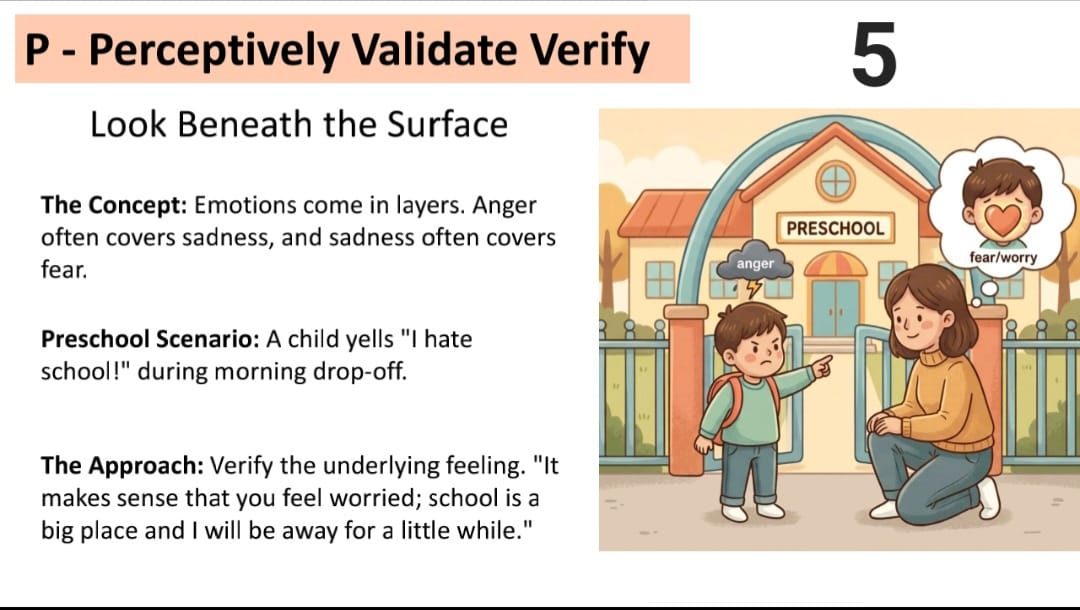
| P - Perceptively Validate & Verify | Acknowledge that the emotion makes sense. Identify the layers (e.g., anger often covers fear, worry, or sadness). |
Scenario: A child yells, "I hate school!" at drop-off. Approach: Verify the underlying feeling: "It makes sense that you feel worried; school is a big place and I will be away for a little while." |
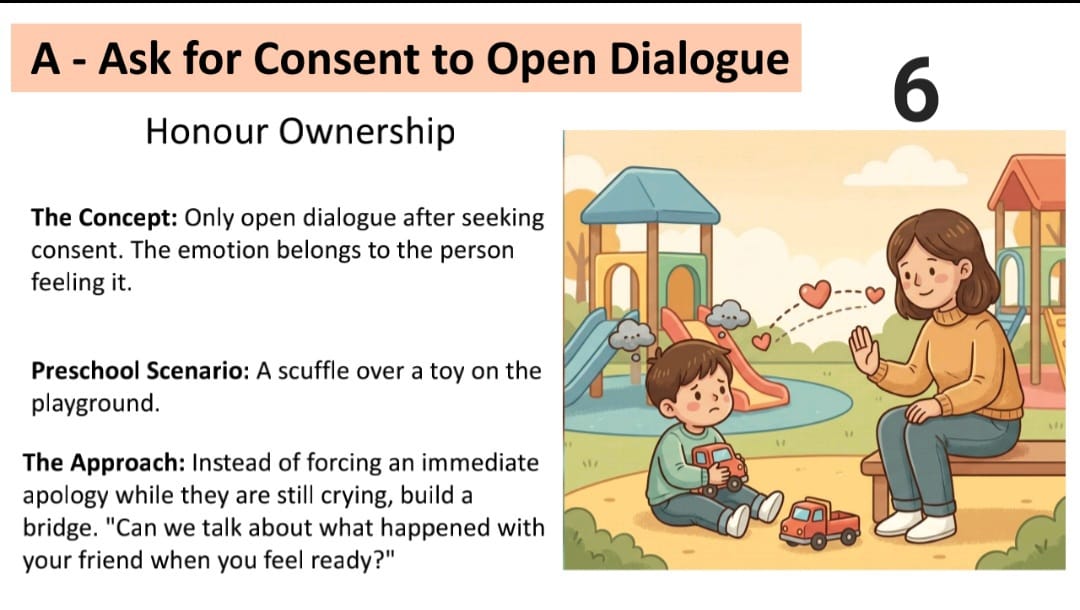
| A - Ask for Consent to Open Dialogue | Honor ownership. Emotions belong to the person feeling them. Seek permission before opening a discussion. |
Scenario: A playground scuffle over a toy. Approach: Instead of forcing an immediate apology, build a bridge: "Can we talk about what happened with your friend when you feel ready?" |
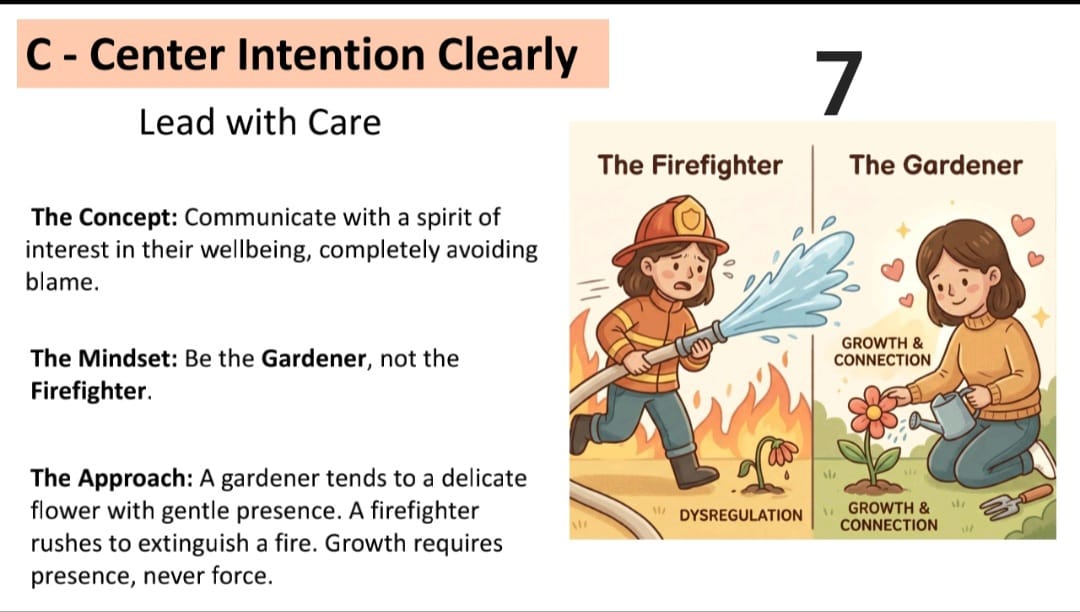
| C - Center Intention Clearly | Lead with clarity and care, avoiding blame. Be the Gardener, tending a flower for growth and connection, not a Firefighter rushing to extinguish a fire. | Mindset: Communicate with a spirit of interest in their wellbeing. Growth requires gentle presence, never force. |
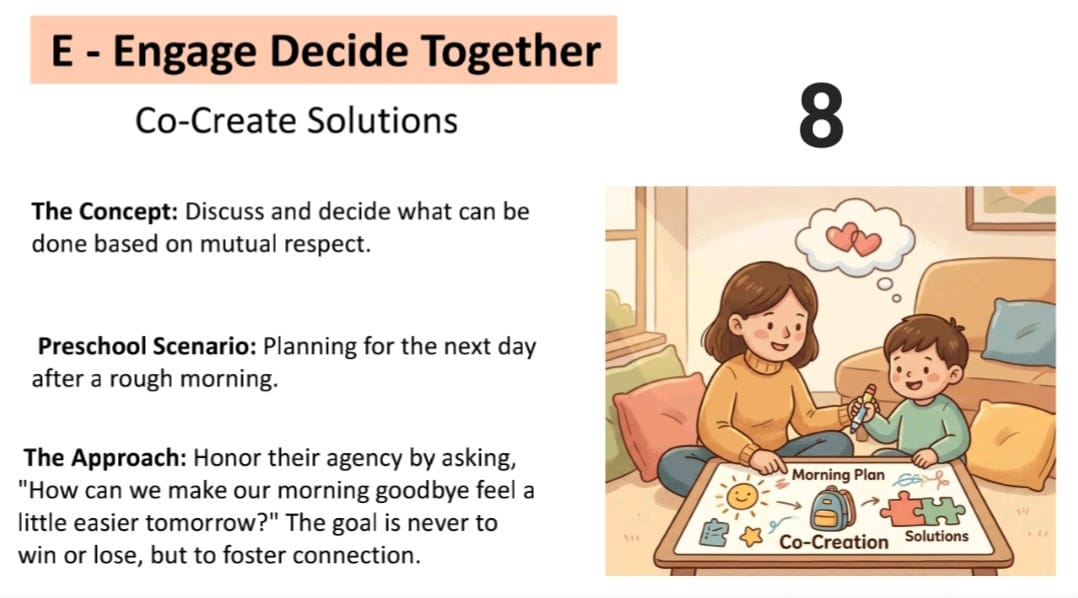
| E - Engage and Decide Together | Co-create solutions. Jointly discuss next steps based on mutual respect and shared goals. |
Scenario: Planning after a rough morning. Approach: Honor their growing agency: "How can we make our morning goodbye feel a little easier tomorrow?" |
Our aim is not to enforce constant peace, but to build the capacity to navigate an unpredictable world together. By establishing safety inside the body through regulation, and outside the body through relationship, we build strong emotional connections, one step at a time.
